Solar-Powered Water Pumping
Solar-Powered Water Pumping Transforming Rural Water Supply in Ethiopia
Access to safe drinking water remains a major challenge in many rural areas of Ethiopia. Traditionally, communities have relied on diesel-powered pumps or manual water collection from rivers, springs, and shallow wells. However, the expansion of solar-powered water pumping systems is increasingly transforming rural water supply across the country.
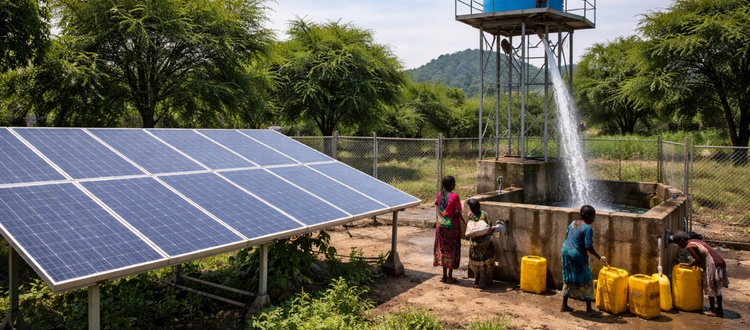
Solar pumping technology uses photovoltaic panels to generate electricity that powers submersible pumps installed in boreholes or wells. The water is then pumped to storage tanks and distributed to communities through gravity-fed systems or standpipes.
Compared to diesel-powered systems, solar pumps offer several advantages. They require no fuel, have lower operating costs, and produce no greenhouse gas emissions. This makes them particularly suitable for remote regions where fuel transportation is difficult and expensive.
In several regions of Ethiopia, solar-powered pumping systems have been successfully installed to supply clean water to villages, schools, and health centers. These systems reduce the time women and children spend fetching water and improve public health by providing reliable access to safe drinking water.
However, solar pumping also requires careful design and management. Engineers must evaluate groundwater availability, pump capacity, solar radiation levels, and storage requirements to ensure sustainable operation.
As Ethiopia continues to expand its rural water infrastructure, solar-powered water systems are emerging as an important solution for delivering clean water in a cost-effective and environmentally sustainable way.