Memorandum of Understanding among the Founding Partners of Aqua Nile Engineering Consultancy
A members-only charter page for reading, internal review, and later digital confirmation by the founding partners.
Founding Memorandum Statement
Founding Memorandum Statement
We, the founding members of Aqua Nile Engineering Consultancy, hereby declare our shared intention to establish and develop this organization upon a foundation of service, professional integrity, technical excellence, and collective responsibility.
We affirm that this company is not being created merely as a vehicle for financial gain, but first and foremost as an institution of service. Its primary purpose is to contribute meaningfully to society through engineering, water resources knowledge, infrastructure development, and practical solutions that respond to real human and environmental needs.
We further affirm that one of the central purposes of this organization is to create opportunity, dignity, and professional space for fellow Africans by building a serious and credible platform through which African experts, engineers, and technical professionals may contribute their knowledge, develop their careers, and serve their communities with competence and honor.
We recognize that financial sustainability and benefit are necessary for the life and continuity of the company. However, we declare that financial benefit shall remain a secondary and collateral outcome of honest service, and not the sole or governing purpose of our association.
As founding partners, we therefore commit ourselves to the following principles:
- To uphold service as the first mission of the company.
- To work in a spirit of honesty, mutual respect, and professional discipline.
- To use our knowledge and skills for constructive and responsible purposes.
- To create and protect opportunities for qualified African professionals.
- To avoid personal conduct that would damage the unity, reputation, or mission of the company.
- To govern the company through clear rules, shared responsibility, and written agreement.
- To ensure that leadership, decision-making, and financial matters are handled transparently and fairly.
- To build an institution that can grow in strength, credibility, and long-term impact.
By this memorandum, we express our common will to be bound together by a purpose greater than individual interest alone. We undertake to prepare and adopt the necessary rules, charter, organizational structure, and agreements required for the sound establishment and future growth of Aqua Nile Engineering Consultancy.
This memorandum stands as a declaration of our founding spirit, our common vision, and our collective commitment to service.
1. Preamble
We, the undersigned founding members of Aqua Nile Engineering Consultancy, hereby declare our common intention to establish this organization upon the principles of service, professional excellence, integrity, and shared responsibility.
This company is being formed not solely for commercial gain, but primarily to serve: to provide sound engineering solutions, to respond to real developmental needs, and to create professional opportunity for qualified African experts and practitioners. We are united by the belief that engineering knowledge must be used responsibly and constructively for the benefit of society, and that an institution built on discipline, competence, and purpose can make a meaningful contribution to the development of Africa and beyond.
We acknowledge that financial sustainability is essential for the stability and continuity of the company. However, we affirm that financial benefit shall remain secondary to the deeper mission of service, impact, and professional contribution. Our association is therefore founded on a shared cause greater than personal interest alone.
By this memorandum, we express our commitment to build and govern Aqua Nile Engineering Consultancy in a spirit of unity, accountability, fairness, and mutual respect, so that it may grow into a credible and enduring institution of service and excellence.
2. Name of the Company
The name of the company shall be: Aqua Nile Engineering Consultancy
The company may also operate, where appropriate and legally permissible, under the shorter professional name:
Aqua Nile Engineering
Under this name, the organization shall carry out its professional activities in the fields of water resources engineering, hydrology, hydraulics, irrigation engineering, dam engineering, civil infrastructure, environmental services, and related consultancy services consistent with its founding purpose and mission.
The name Aqua Nile Engineering Consultancy shall represent the identity, vision, and professional character of the organization, and shall be used in all official, legal, administrative, contractual, and professional matters unless otherwise decided by the founders in accordance with the governing rules of the company.
3. Registered Office and Scope of Operation
The registered office of Aqua Nile Engineering Consultancy shall be established at such location as may be agreed upon by the founding members and recorded in the official registration documents of the Company. The founders may, by mutual agreement and in accordance with applicable law, change the registered office or establish branch offices, representative offices, or project offices whenever necessary for the effective operation and growth of the Company.
The Company shall be established as a professional engineering consultancy with the authority to operate in its country of registration and, where legally permitted, in other countries through partnerships, branch arrangements, project agreements, or other lawful forms of professional engagement.
The scope of operation of the Company shall include, but shall not be limited to, the following areas:
- water resources engineering
- hydrology and hydraulics
- irrigation engineering and agricultural water management
- dam engineering, dam safety, and hydraulic structures
- engineering geology and geotechnical investigations related to water infrastructure
- water supply, sanitation, and sanitary engineering
- civil engineering and built environment works related to water and infrastructure development
- flood assessment, drought studies, watershed management, and river basin planning
GIS, remote sensing, data analysis, and technical modelling related to engineering and environmental systems
construction supervision, project management, technical advisory services, feasibility studies, design, and related consultancy assignments
The Company may also undertake any other professional, technical, advisory, training, research, or development activities that are consistent with its mission, its engineering character, and the laws and regulations governing its operations.
In carrying out its work, the Company shall seek to serve public and private clients, development institutions, communities, and partner organizations, especially in areas where sound engineering knowledge and responsible technical support can contribute to sustainable development and practical solutions.
4. Founding Purpose and Mission
Aqua Nile Engineering Consultancy is founded primarily as an institution of service. Its purpose is to bring together professional knowledge, engineering skill, and practical experience in order to contribute meaningful solutions in the fields of water resources, infrastructure, environment, and development.
The Company is established on the belief that engineering is not merely a commercial activity, but also a responsibility to society. Its founding purpose is therefore to provide sound, reliable, and responsible technical services that respond to real human, environmental, and developmental needs, especially in Africa and in other regions where such expertise may be of value.
A central part of the mission of the Company is to create professional opportunity for qualified Africans by building a credible platform through which African engineers, hydrologists, geologists, technical experts, and related professionals may contribute their knowledge, strengthen their careers, and serve with dignity, competence, and integrity.
The mission of the Company shall therefore include the following:
- To provide high-quality engineering consultancy and technical services in areas related to water, infrastructure, environment, and development.
- To contribute practical and sustainable solutions to engineering challenges affecting communities, institutions, and development partners.
- To promote professional excellence, technical integrity, and responsible engineering practice.
- To create and expand opportunities for African professionals to participate meaningfully in consultancy, design, research, supervision, and development work.
- To build a respected institution capable of serving both present and future generations through knowledge, discipline, and long-term vision.
- To work in partnership with public institutions, private clients, development organizations, and communities where such collaboration advances the mission of service.
The founders affirm that while financial sustainability is necessary for the continuity, growth, and strength of the Company, financial gain shall not be regarded as the sole or highest aim of the organization. Rather, it shall be understood as a legitimate and necessary result of honest work, professional value, and faithful service.
Accordingly, the Company shall seek to balance service, institutional growth, professional opportunity, and financial sustainability in a manner consistent with its founding principles and long-term vision.
5. Core Values and Guiding Principles
The founders of Aqua Nile Engineering Consultancy agree that the Company shall be governed and guided by the following core values and principles, which shall define its character, shape its conduct, and direct its decisions and operations.
5.1 Service
The Company shall be founded first upon service. Its work shall be directed toward providing useful, responsible, and meaningful engineering support that contributes to society, development, and practical solutions to real challenges.
5.2 Integrity
The Company shall conduct its affairs with honesty, transparency, and moral responsibility. The founders and all persons acting on behalf of the Company shall uphold truthfulness, professional ethics, and fairness in all dealings, decisions, communications, and commitments.
5.3 Professional Excellence
The Company shall strive for high standards of technical quality, competence, diligence, and continuous improvement. All work undertaken in the name of the Company shall aim to reflect seriousness, accuracy, sound judgment, and professional care.
5.4 Accountability
The Company shall promote responsibility at every level of its structure. Each founder, officer, employee, consultant, or representative shall be accountable for the duties entrusted to them, for the quality of their work, and for the proper use of the Company’s resources, reputation, and opportunities.
5.5 Mutual Respect
The founders shall work together in a spirit of respect, dignity, and constructive cooperation. Differences in opinion shall be handled with maturity and fairness, and no member shall act in a manner that undermines the dignity, role, or legitimate contribution of another.
5.6 Unity of Purpose
The Company shall be sustained by a shared sense of mission. The founders recognize that the strength of the organization depends upon unity in purpose, loyalty to the common cause, and commitment to the long-term interests of the institution above narrow personal advantage.
5.7 Fairness and Equity
The Company shall seek fairness in leadership, opportunity, reward, responsibility, and treatment. Decisions affecting the founders, staff, consultants, and collaborators shall be guided by justice, objectivity, and due consideration of merit and contribution.
5.8 Opportunity for African Professionals
A central principle of the Company shall be the creation, protection, and expansion of professional opportunity for qualified African experts and practitioners. The Company shall endeavor to build a credible and dignified platform through which African knowledge, skill, and contribution may be recognized and advanced.
5.9 Collaboration and Partnership
The Company shall value collaboration within the organization and with external institutions, communities, and partners. It shall seek to work constructively with others where such cooperation supports the mission, strengthens results, and serves the broader good.
5.10 Sustainability and Long-Term Vision
The Company shall not operate merely for short-term gain. It shall seek to build a lasting institution capable of sustained impact, financial continuity, technical credibility, and responsible contribution over time.
5.11 Responsible Stewardship
The Company shall treat its resources, opportunities, professional name, and client trust as matters of stewardship. Financial resources, technical outputs, institutional relationships, and public reputation shall be managed carefully and responsibly for the benefit of the mission and the future of the organization.
5.12 Commitment to Society
The Company shall recognize that engineering carries a wider social responsibility. It shall therefore seek, wherever possible, to contribute through its work to improved livelihoods, stronger institutions, better infrastructure, sound water management, and constructive development outcomes.
Together, these values and guiding principles shall serve as the ethical and professional foundation of Aqua Nile Engineering Consultancy, and all founders and future members of the Company shall be expected to uphold them in both spirit and practice.
Here is a shorter, more formal ending sentence you may prefer:
These core values and guiding principles shall guide the conduct, decisions, relationships, and institutional direction of the Company, and shall remain binding in spirit upon all founders, officers, and members acting in its name.
6. Founding Members and Their Commitment
The Company is founded by the following founding members, who have voluntarily come together in a spirit of shared purpose, professional cooperation, and commitment to service:
These founding members hereby affirm that they unite not merely as individuals pursuing personal benefit, but as partners committed to building a credible, disciplined, and service-oriented professional institution.
Each founding member agrees to contribute, according to his capacity and agreed role, to the establishment, development, and strengthening of the Company. Such contribution may include professional knowledge, technical service, leadership, institutional support, financial input, business development effort, administrative support, reputation, networks, time, and other lawful forms of contribution necessary to the life and growth of the Company.
The founding members further declare and undertake the following commitments:
6.1 Commitment to the Founding Purpose
Each founding member commits himself to uphold the founding purpose and mission of the Company, namely to serve through sound engineering practice, to contribute to development, and to create meaningful professional opportunity, especially for qualified African experts and practitioners.
6.2 Commitment to Unity and Cooperation
Each founding member agrees to work in a spirit of cooperation, mutual respect, and institutional loyalty. The founders acknowledge that the strength of the Company depends upon unity of purpose, disciplined collaboration, and the avoidance of conduct that may create unnecessary division or mistrust.
6.3 Commitment to Professional Integrity
Each founding member shall conduct himself with honesty, seriousness, and professional responsibility in all matters relating to the Company. No founder shall knowingly act in a way that compromises the ethical standing, technical credibility, legal position, or public reputation of the Company.
6.4 Commitment to Active Contribution
Each founding member shall make a genuine and reasonable effort to contribute to the Company according to agreed duties, roles, and capacities. Founding status shall not be merely symbolic, but shall carry with it an expectation of real participation, responsibility, and support.
6.5 Commitment to Transparency and Fair Dealing
Each founding member agrees to act transparently and fairly in matters affecting the Company, including financial matters, business opportunities, project participation, use of company property or name, and relations with clients, partners, and fellow founders.
6.6 Commitment to the Protection of the Company
Each founding member shall protect the interests, reputation, mission, and continuity of the Company. No founder shall misuse the Company’s name, opportunities, contacts, technical resources, confidential information, or institutional standing for improper personal benefit or in a manner contrary to the common interest of the founders.
6.7 Commitment to Written Rules and Lawful Governance
Each founding member agrees that the Company shall be governed by written rules, agreed procedures, lawful authority, and collective discipline, and not by assumption, confusion, or arbitrary conduct. The founders therefore undertake to respect this Memorandum, the Organizational Charter, and such other policies and agreements as may be lawfully adopted.
6.8 Commitment to Long-Term Institution Building
Each founding member agrees to act not only for immediate benefit, but for the long-term credibility, stability, and success of the Company as an institution of service and professional excellence.
By these commitments, the founding members bind themselves in principle to the common cause for which the Company is established, and they affirm their intention to work together in good faith for the advancement of its mission and the responsible achievement of its objectives.
8. Organizational Structure and Offices
For the effective functioning of Aqua Nile Engineering Consultancy, the founders agree that the Company shall be organized through a clear and orderly structure of governance, executive leadership, technical coordination, and administrative support. This structure is intended to ensure clarity of authority, efficiency of operation, accountability in management, and readiness for future growth.
The Company shall, at its initial stage, adopt a lean organizational structure appropriate for a professional consultancy founded by a limited number of partners, while retaining the capacity to expand into a more developed institutional form as its work, staffing, and responsibilities increase.
8.1 Founding Body
The founding members shall constitute the original founding body of the Company. In this capacity, they shall provide collective oversight over the identity, mission, foundational direction, and major institutional decisions of the Company, subject to the provisions of this Memorandum and applicable law.
8.2 Chairperson or President
The Company may designate a Chairperson or President from among the founders, or as otherwise agreed, to provide strategic guidance, support unity among the founders, represent the institutional vision of the Company, and assist in high-level external relations, partnerships, and liaison with relevant organizations.
The Chairperson or President shall not necessarily be responsible for the day-to-day management of the Company unless such additional role is specifically assigned by agreement.
8.3 Chief Executive Officer / Managing Director
The Company shall appoint a Chief Executive Officer (CEO) or Managing Director to serve as the principal executive head of the organization. The CEO or Managing Director shall be responsible for the day-to-day leadership, management, coordination, and execution of the Company’s operations, subject to the governance framework established by the founders.
The CEO or Managing Director shall work to ensure that the mission, technical work, administration, and business development functions of the Company are properly coordinated and effectively carried out.
8.4 Main Functional Offices
At the initial stage, the Company shall organize its work through the following principal offices or functional arms:
a. Office of Administration and Finance
This office shall be responsible for administrative coordination, finance, accounting, budgeting, salaries, records, logistics, communication support, office management, and related operational matters necessary for the orderly functioning of the Company.
b. Office of Business Development and Partnerships
This office shall be responsible for identifying tenders and opportunities, supporting proposal preparation, developing institutional relationships, maintaining client and partner communication, promoting the visibility of the Company, and contributing to the growth and sustainability of the organization.
c. Office of Technical Operations
This office shall oversee the professional and technical work of the Company. It shall coordinate technical services, project execution, quality review, and the work of the technical departments or sections of the Company.
8.5 Technical Departments or Sections
Under the technical structure of the Company, the following initial departments or sections may be established:
Dam Engineering, Engineering Geology, and Dam Safety including dam design, spillway and hydraulic structure design, geological and geotechnical investigations, dam safety assessment, rehabilitation, and related construction support.
Irrigation Engineering including surface irrigation, pressurized and pipe irrigation, drainage, irrigation network planning, and agricultural water management.
Hydrology, Hydraulics, and GIS including surface water hydrology, groundwater studies, hydraulic analysis and modelling, watershed assessment, flood and drought studies, GIS, remote sensing, and related data analysis.
Built Environment and Civil Infrastructure including structural engineering, sanitary engineering, water supply-related works, reservoirs, utility infrastructure, and other associated civil engineering services.
The founders may create, merge, divide, rename, or expand such departments as may be required by the growth, specialization, or operational needs of the Company.
8.6 Supporting and Project-Based Staff
The Company may also engage permanent, temporary, part-time, or project-based personnel as required for its activities. Such personnel may include, but shall not be limited to, surveyors, draftsmen, CAD technicians, GIS technicians, field technicians, laboratory personnel, machine operators, drivers, secretarial staff, and other supporting staff necessary for the effective implementation of office and field assignments.
8.7 Appointment to Offices
Persons appointed to offices within the Company shall be assigned duties and authority consistent with the needs of the organization, their competence, and the decisions of the founders or authorized leadership. The title of any office shall carry real responsibility, and each office holder shall remain accountable for the performance of his duties.
8.8 Flexibility and Future Development
The founders acknowledge that the organizational structure described herein reflects the initial stage of the Company and may be revised, expanded, or further formalized as the Company grows. Additional offices may later be established, including legal, audit, quality assurance, project management, regional coordination, or other specialized functions, as may be appropriate to the scale and complexity of the Company’s operations.
8.9 Organizational Chart
The Company may adopt an organizational chart as a visual representation of its structure, hierarchy, reporting lines, and major functional offices. Such chart, once approved, shall serve as an administrative reference but shall remain subject to this Memorandum and any subsequent Organizational Charter or internal governance instruments.
In this way, the organizational structure of the Company shall serve as a practical framework for coordinated work, disciplined leadership, and institutional growth, while remaining faithful to the founding purpose of service, opportunity, and professional excellence.
9. Roles and Responsibilities of Principal Offices
In order to ensure clarity of function, discipline of operation, and accountability in leadership, the principal offices of Aqua Nile Engineering Consultancy shall carry the roles and responsibilities set out below. These offices shall work in coordination with one another and in fidelity to the founding purpose, mission, and governing principles of the Company.
9.1 Founding Body
The Founding Body, consisting of the founding members of the Company, shall serve as the original collective authority responsible for safeguarding the identity, mission, founding purpose, and long-term direction of the Company.
Its principal responsibilities shall include:
- preserving the founding vision and institutional character of the Company
- approving major structural, strategic, and governance decisions
- appointing or confirming principal leadership positions, as may be agreed
- approving major institutional commitments, policies, or changes affecting the future of the Company
- ensuring that the Company remains faithful to its mission of service, professional integrity, and opportunity creation
- resolving major matters that exceed the authority of ordinary executive management
The Founding Body shall act in a manner that promotes unity, continuity, and the long-term interests of the institution.
9.2 Chairperson or President
The Chairperson or President shall provide strategic guidance and moral leadership to the Company. This office shall primarily serve the unity, visibility, and higher external positioning of the organization.
Its responsibilities may include:
- providing strategic counsel to the Company and its leadership
- helping preserve unity among the founders
- representing the institutional vision and character of the Company at high level
- supporting relationships with public institutions, development organizations, professional bodies, and strategic partners
- assisting in fundraising, partnership-building, and institutional liaison
- advising on major matters affecting the reputation and future of the Company
- supporting the orderly functioning of governance processes among the founders
Unless otherwise specifically assigned, the Chairperson or President shall not be responsible for the routine day-to-day management of the Company.
9.3 Chief Executive Officer / Managing Director
The Chief Executive Officer (CEO) or Managing Director shall be the principal executive head of the Company and shall be responsible for its day-to-day management, operational coordination, and implementation of its mission and plans.
The responsibilities of this office shall include:
- leading the daily operations of the Company
- implementing the decisions of the founders and the approved direction of the Company
- coordinating the work of the principal offices, departments, and staff
- overseeing administration, finance, business development, and technical operations
- ensuring the proper execution of projects, assignments, and institutional commitments
- supervising performance, discipline, and accountability across the organization
- supporting business growth, operational stability, and service delivery
- reporting to the founders or other competent governance authority as may be established
- ensuring that the Company operates in accordance with its mission, policies, and applicable law
The CEO or Managing Director shall exercise leadership as a duty of stewardship, accountability, and service to the institution.
9.4 Office of Administration and Finance
The Office of Administration and Finance shall be responsible for the orderly internal functioning of the Company and for the sound handling of its administrative and financial affairs.
Its responsibilities shall include:
- financial management, accounting, and budgeting
- preparation and maintenance of financial records
- payroll, allowances, and related administrative financial matters
- office administration and internal operational coordination
- human resource support and personnel records
- procurement support, logistics, and office supplies
- management of vehicles, equipment, and operational assets
- document control, filing, records management, and internal communication support
- assisting leadership in maintaining administrative discipline and operational order
This office shall seek to ensure transparency, efficiency, and accountability in the use of the Company’s resources.
9.5 Office of Business Development and Partnerships
The Office of Business Development and Partnerships shall be responsible for supporting the growth, external engagement, and institutional sustainability of the Company.
Its responsibilities shall include:
- identifying tenders, consultancy opportunities, and calls for proposals
- coordinating or supporting proposal preparation and submission
- maintaining communication with clients, partners, and relevant institutions
- promoting the professional visibility and external profile of the Company
- supporting the development of strategic partnerships and collaborative opportunities
- assisting in contract follow-up, opportunity tracking, and market engagement
- helping the Company expand its network, client base, and institutional relations
- contributing to the long-term sustainability and growth of the Company through professional outreach and opportunity development
This office shall work closely with both executive leadership and technical staff to ensure that opportunities are matched by real institutional capacity and competence.
9.6 Office of Technical Operations
The Office of Technical Operations shall be responsible for the professional and technical work of the Company. It shall serve as the main coordinating office for technical assignments, engineering quality, and project implementation.
Its responsibilities shall include:
- overseeing the technical execution of projects and consultancy assignments
- coordinating the work of technical departments, units, and specialists
- ensuring quality, consistency, and technical soundness in outputs prepared in the name of the Company
- supporting technical planning, design review, supervision, and project delivery
- assigning or coordinating technical responsibilities according to competence and project need
- promoting professional standards, technical discipline, and methodological rigor
- assisting in the preparation of technical proposals, methodologies, and work plans
- ensuring that technical services are aligned with client requirements, professional ethics, and the Company’s mission
This office shall serve as a central pillar of the Company’s credibility and technical excellence.
9.7 Technical Departments or Sections
The technical departments or sections established under the Company shall each be responsible for their respective fields of specialization, while remaining coordinated within the overall technical structure of the Company.
a. Dam Engineering, Engineering Geology, and Dam Safety
This section shall be responsible for work related to:
- dam planning and design
- spillway and hydraulic structure design
- engineering geology and geotechnical investigation
- dam safety assessment, inspection, and rehabilitation
- construction support and supervision related to dam infrastructure
- associated reservoir and structural works
b. Irrigation Engineering
This section shall be responsible for work related to:
- surface irrigation systems
- pipe and pressurized irrigation systems
- drainage and irrigation network design
- agricultural water management
- irrigation modernization and scheme development
- related technical studies and supervision services
c. Hydrology, Hydraulics, and GIS
This section shall be responsible for work related to:
- surface water hydrology
- groundwater studies
- hydraulic analysis and modelling
- flood studies, drought studies, and watershed assessment
- basin planning and water resources analysis
GIS, remote sensing, and related technical data services
d. Built Environment and Civil Infrastructure
This section shall be responsible for work related to:
- structural engineering
- sanitary engineering
- water supply-related civil works
- reservoirs and associated infrastructure
- utility and built-environment systems
- related civil engineering planning, design, and supervision services
Each technical section shall work within its professional scope while supporting interdisciplinary cooperation wherever necessary.
9.8 Supporting and Project-Based Staff
Supporting and project-based staff shall provide the practical, administrative, field, and technical support necessary for the implementation of the Company’s work.
Their responsibilities may include:
- surveying and field measurement
- drafting, CAD, and technical drawing support
GIS and data processing assistance
laboratory or field technical work
operation of vehicles, machinery, or equipment
secretarial and clerical support
logistical and operational assistance for project execution
other support functions required by the needs of the Company
Such staff shall operate under the authority of the relevant office, section, or project leadership to which they are assigned.
9.9 Duty of Coordination
All principal offices and sections of the Company shall work in coordination and not in isolation. Each office shall respect the mandate of the others, and all shall contribute to the common purpose of the Company. Where responsibilities overlap, the matter shall be clarified through proper leadership, written assignment, or agreed procedure, so that confusion and conflict may be avoided.
9.10 Accountability of Office Holders
Every person entrusted with a principal office or recognized responsibility within the Company shall remain accountable for the proper exercise of his role, the discharge of his duties, and the protection of the mission, resources, and reputation of the Company.
The holders of principal offices shall therefore be expected to act with competence, discipline, transparency, and loyalty to the institution.
10. Decision-Making and Authority
In order to preserve unity, prevent misunderstanding, and ensure orderly governance, the founders of Aqua Nile Engineering Consultancy agree that decision-making and authority within the Company shall be exercised through clear rules, defined levels of responsibility, and respect for the institutional structure established under this Memorandum.
The purpose of this section is to ensure that authority is neither confused nor abused, that major matters are decided collectively where necessary, and that ordinary operations may proceed efficiently under properly delegated leadership.
10.1 General Principle
Authority within the Company shall be exercised according to the nature, importance, and impact of the matter concerned. Matters affecting the identity, ownership, mission, structure, and long-term future of the Company shall be reserved to the founders collectively, while day-to-day management and ordinary operational matters may be handled by duly authorized executive leadership and office holders.
10.2 Authority of the Founding Members
The founding members, acting collectively as the founding body, shall retain the highest authority in respect of major matters affecting the Company, including but not limited to:
- amendment of the Founding Memorandum or Organizational Charter
- admission of a new founder, partner, or shareholder
- removal or replacement of a founder from the governing structure, subject to law and due process
- change in ownership structure or transfer of significant ownership interest
- appointment, confirmation, or removal of the Chairperson, President, CEO, or Managing Director, where applicable
- approval of major strategic changes affecting the mission, identity, or long-term direction of the Company
- approval of merger, dissolution, sale, restructuring, or major institutional transformation
- approval of exceptionally large financial commitments, borrowing, or contractual obligations beyond thresholds to be agreed by the founders
- establishment or closure of branch offices, regional offices, or major new operational divisions
- approval of any matter expressly reserved to the founders by this Memorandum or by later written agreement
10.3 Decisions Requiring Unanimous Approval
The following matters shall, as far as possible, require the unanimous approval of all founding members:
- amendment of the core mission, founding purpose, or essential identity of the Company
- admission of a new founding-level partner or equivalent ownership-level member
- dissolution of the Company
- sale of the whole Company or a major controlling interest in it
- voluntary removal of a founder’s essential ownership rights without that founder’s consent, except as otherwise provided by law or by a separately agreed binding arrangement
- any matter which the founders have expressly declared to require unanimity
The founders may, by later written agreement, define more precisely which matters shall remain subject to unanimous approval.
10.4 Decisions Requiring Qualified Majority
The following matters may be decided by a qualified majority of the founders, which for the purposes of this Memorandum shall mean not less than two-thirds of the founding members, unless a stricter requirement is agreed:
- appointment or replacement of senior executive leadership
- approval of annual strategic plans
- approval of major institutional policies
- approval of significant investments or commitments not requiring unanimity
- creation of major new departments, offices, or leadership structures
- approval of long-term partnerships, alliances, or institutional arrangements of major consequence
- approval of borrowing, guarantees, or major expenditures above normal operational levels but below the level requiring unanimity
10.5 Decisions by Simple Majority
Ordinary governance matters not reserved for unanimity or qualified majority may be decided by a simple majority of the founding members present and entitled to vote, provided that quorum is met.
Such matters may include:
- routine internal approvals at founder level
- endorsement of operational recommendations
- approval of ordinary internal procedures
- scheduling, administrative decisions, and other non-fundamental matters
10.6 Quorum
No formal decision of the founding members shall be valid unless quorum is met. For the purposes of founder-level decisions, quorum shall consist of not less than two-thirds of the founding members, unless a different standard is later agreed in writing.
Where a matter requires unanimity, all founders should be duly notified and given a fair opportunity to participate in the decision.
10.7 Authority of the Chairperson or President
The Chairperson or President shall have such authority as is assigned under this Memorandum or by decision of the founders. This office shall ordinarily exercise strategic, representative, advisory, and facilitative authority rather than routine executive management authority.
Unless expressly authorized, the Chairperson or President shall not unilaterally bind the Company in ordinary operational, financial, staffing, or contractual matters reserved to executive management or collective decision.
10.8 Authority of the CEO / Managing Director
The CEO or Managing Director shall have authority over the day-to-day operations of the Company, subject to this Memorandum, the authority of the founders in reserved matters, and such internal limits as may be established by policy or resolution.
This authority shall ordinarily include:
- management of daily operations
- coordination of offices, departments, staff, and routine institutional functions
- implementation of approved plans, projects, and policies
- oversight of proposal preparation, project execution, and internal administration
- supervision of staff and office holders
- approval of routine operational expenditures within authorized limits
- representation of the Company in ordinary professional and administrative matters
- execution of contracts or commitments within approved authority limits
The CEO or Managing Director shall not exceed the financial, contractual, structural, or strategic authority assigned to that office by the founders.
10.9 Authority of Principal Offices and Office Holders
Each principal office or department head shall exercise authority only within the scope of the office assigned to him and the responsibilities lawfully delegated to that office.
No office holder shall:
- assume authority not granted to his office
- bind the Company outside his mandate
- interfere improperly with the responsibilities of another office
- make major commitments in the name of the Company without proper authorization
Each office holder shall remain accountable to the appropriate leadership and governance structure of the Company.
10.10 Delegation of Authority
Authority may be delegated in writing, whether generally or for a specific matter, where such delegation is necessary for efficiency and proper functioning. Any delegation of authority shall be clear in scope, duration, and limits.
Delegation shall not remove the accountability of the person or body originally holding such authority, unless otherwise expressly provided.
10.11 Written Record of Major Decisions
Major decisions of the founders and major institutional decisions of executive leadership shall, as far as practicable, be recorded in writing. Such record may take the form of minutes, resolutions, memoranda, written approvals, or other appropriate documentation.
This is necessary to preserve clarity, accountability, and institutional memory.
10.12 Good Faith and Institutional Interest
All decisions taken under this section shall be made in good faith, with due regard to the mission of the Company, the unity of the founders, the lawful interests of the institution, and the long-term credibility and sustainability of the organization.
No authority conferred under this Memorandum shall be used arbitrarily, abusively, or in a manner contrary to the founding purpose and values of the Company.
10.13 Further Internal Rules
The founders may, by later written agreement, adopt more detailed internal rules concerning financial thresholds, signing authority, procurement authority, staffing authority, project approvals, and voting procedures, provided that such rules remain consistent with this Memorandum.
10.14 Authority Matrix
For greater clarity and practical administration, the founders may later adopt a simple Authority Matrix setting out which level of leadership may approve, decide, or authorize particular matters.
Such a matrix may, for example, provide that:
- expenditures or commitments below a specified financial threshold may be approved by the CEO / Managing Director
- expenditures or commitments above a specified financial threshold shall require the approval of the founding members or such other higher authority as may be designated
- the hiring of temporary or project-based staff may be approved by the CEO / Managing Director, within the limits of approved budgets and operational need
- the appointment of directors, heads of office, or other principal leadership positions shall require approval by the founding members
- the opening of a branch office, regional office, or other major operational office shall require approval by the founding members
The founders may further define financial thresholds, categories of authority, and levels of approval in writing as the Company grows, provided that such rules remain consistent with this Memorandum and the governance principles of the Company.
11. Financial Principles and Stewardship
The founders of Aqua Nile Engineering Consultancy agree that the financial life of the Company shall be governed by discipline, transparency, accountability, fairness, and responsible stewardship. Since the Company is founded upon a mission of service and institution-building, its financial resources shall be managed carefully and honorably, in a manner that protects both its continuity and its integrity.
The purpose of this section is to ensure that money, assets, revenues, and financial opportunities are handled with clarity and responsibility, so that the Company may remain stable, credible, and faithful to its founding purpose.
11.1 Principle of Financial Integrity
All financial matters of the Company shall be conducted honestly, accurately, and in good faith. No founder, officer, employee, or representative shall misuse, conceal, divert, or improperly benefit from the financial resources, property, or opportunities of the Company.
11.2 Principle of Transparency
The financial affairs of the Company shall be managed with transparency. Proper records shall be kept of income, expenditure, assets, liabilities, contracts, payments, salaries, allowances, and other financial transactions. Founders shall have access, within reasonable and proper limits, to financial information necessary for governance, oversight, and trust.
11.3 Principle of Accountability
Every person entrusted with financial responsibility shall remain accountable for the proper use and management of Company resources. Financial authority shall be exercised only within the scope of lawful and assigned responsibility, and no person shall commit the Company to financial obligations without proper authorization.
11.4 Company Funds and Accounts
All funds belonging to the Company shall, as far as practicable, be held in the name of the Company and managed through official and traceable financial channels. Company income shall not be mixed with personal funds of any founder or staff member, except where temporary reimbursement or lawful exception is properly documented and approved.
The Company shall maintain appropriate bank accounts, financial records, and supporting documentation in accordance with applicable law and sound administrative practice.
11.5 Use of Financial Resources
The financial resources of the Company shall be used only for lawful, authorized, and mission-consistent purposes, including but not limited to:
- operational expenses
- staff salaries and allowances
- project implementation costs
- office administration and logistics
- professional services and technical work
- institutional development and growth
- acquisition or maintenance of equipment, software, and vehicles
- training, quality improvement, and necessary business development activities
No Company funds shall be used arbitrarily or for personal purposes unrelated to the approved activities or legitimate needs of the Company.
11.6 Budgets and Financial Planning
The Company shall, where practicable, operate on the basis of approved budgets or financial plans. Major expenditures should, as far as possible, be linked to budgetary provision, project need, or approved management decision. Sound planning shall be encouraged so that the Company may remain financially stable and capable of meeting its obligations.
11.7 Revenue and Income of the Company
All revenues earned through contracts, consultancy services, studies, designs, supervision assignments, partnerships, or other lawful Company activities shall belong in principle to the Company, unless otherwise provided by written agreement consistent with this Memorandum.
Where a founder or other person brings a business opportunity, client, or project to the Company, the handling of such opportunity, including any commission, recognition, or benefit-sharing arrangement, shall be governed by fairness, transparency, and any written rule or policy adopted by the founders.
11.8 Salaries, Allowances, and Compensation
The Company may provide salaries, allowances, professional fees, honoraria, reimbursements, or other lawful forms of compensation to founders, staff, consultants, or project personnel, according to their role, contribution, assignment, and the financial capacity of the Company.
Such compensation shall be determined in a fair, transparent, and sustainable manner, taking into account:
- actual work performed
- professional responsibility assumed
- financial capacity of the Company
- approved budgets
- project-specific arrangements
- institutional sustainability
Founding status alone shall not automatically entitle a person to unreasonable or unlimited financial benefit without regard to actual contribution, approved rules, or the financial condition of the Company.
11.9 Profit, Surplus, and Reinvestment
The founders acknowledge that the Company must be financially sustainable and may generate profit or surplus through its lawful activities. However, such profit or surplus shall be treated with prudence and responsibility.
The founders may determine, by later written agreement or approved policy, how profit or surplus shall be allocated, including for:
- reinvestment in the growth and strengthening of the Company
- reserves for stability and future operations
- compensation or dividends, where appropriate
- equipment, staffing, and capacity development
- expansion of services or offices
- strategic opportunities aligned with the mission of the Company
In principle, the founders affirm that reinvestment and institutional strengthening should be given due importance, especially in the early stages of the Company’s development.
11.10 Financial Approval and Spending Authority
Financial commitments and expenditures shall be made only by persons duly authorized under the Company’s governance structure or authority matrix. Routine expenditures may be approved within delegated limits, while major expenditures, borrowing, guarantees, or exceptional financial commitments shall require higher approval in accordance with this Memorandum and any related policy.
11.11 Protection of Assets
The assets of the Company, including money, equipment, vehicles, software, documents, intellectual outputs, and contractual rights, shall be treated as institutional property and protected accordingly. No founder, officer, or employee shall appropriate, damage, conceal, misuse, or unlawfully dispose of Company assets.
11.12 Record-Keeping and Financial Reporting
The Company shall maintain proper books, accounts, and supporting records. Financial reports shall be prepared periodically as needed for internal governance, operational management, legal compliance, and institutional accountability.
Where appropriate, the founders may require periodic internal review, external accounting support, or audit arrangements to strengthen trust and sound financial practice.
11.13 Conflict of Interest in Financial Matters
No founder, officer, or representative shall use his position to secure undisclosed personal financial advantage at the expense of the Company. Any personal interest in a contract, financial transaction, procurement matter, or business opportunity affecting the Company should be disclosed in good faith and handled fairly according to agreed rules.
11.14 Financial Stewardship as a Duty
The founders affirm that financial management within the Company is not merely an administrative function, but a form of stewardship. Every person entrusted with Company resources shall handle them carefully, responsibly, and in a manner consistent with the mission, values, and future well-being of the institution.
11.15 Future Financial Policies
The founders may adopt more detailed financial rules in the future, including policies on:
- banking and signatory powers
- procurement and purchasing
- reimbursement procedures
- salary scales and allowances
- treatment of project income and overhead
- reserves and reinvestment
- founder compensation
- dividends or surplus distribution
- audit and internal financial controls
Such policies shall remain consistent with this Memorandum and shall serve to strengthen financial clarity and institutional trust.
In all financial matters, the Company shall seek to preserve both integrity and sustainability, so that its resources may support not only present operations but also the long-term mission, credibility, and service capacity of Aqua Nile Engineering Consultancy.
12. Business Opportunities, Projects, and Benefit Sharing
The founders of Aqua Nile Engineering Consultancy agree that business opportunities, projects, and the benefits arising from them shall be handled in a manner consistent with the mission of the Company, the principles of fairness, transparency, institutional loyalty, and the long-term unity of the founders.
The purpose of this section is to ensure that opportunities brought to the Company are treated responsibly, that project roles are assigned on a rational and professional basis, and that financial and non-financial benefits are distributed in a way that supports both justice and institutional stability.
12.1 Principle of Institutional Opportunity
Any business opportunity, consultancy assignment, client relationship, tender, partnership possibility, or project brought forward for execution under the name of the Company shall, in principle, be regarded as an opportunity of the Company and not as the private property of any individual founder, unless otherwise expressly agreed in writing.
Where a founder introduces, identifies, or helps secure an opportunity, his contribution shall be recognized fairly, but such recognition shall be balanced with the collective nature, mission, and institutional interests of the Company.
12.2 Duty to Present Opportunities in Good Faith
Each founder shall act in good faith in relation to business opportunities relevant to the scope and mission of the Company. No founder shall intentionally divert to himself, conceal, or privately appropriate an opportunity that properly belongs to the Company or that has been developed through the name, network, effort, credibility, or resources of the Company, unless the founders have expressly agreed otherwise.
12.3 Opportunities Brought by Individual Founders
Where a particular founder brings a client, tender, or project opportunity to the Company, that contribution may be recognized in one or more of the following ways, as may later be agreed in writing or by policy:
- acknowledgment of the founder’s role in originating or securing the opportunity
- consideration in assigning project leadership or coordination responsibility
- payment of a reasonable commission, facilitation fee, or business development reward, where appropriate
- consideration in performance recognition or benefit allocation
- other fair arrangements consistent with institutional unity and financial sustainability
Such recognition shall not undermine the principle that projects undertaken in the Company’s name belong to the Company as an institution.
12.4 Tendering and Proposal Opportunities
Tenders, calls for proposals, and similar business opportunities identified by any founder, staff member, or office of the Company shall be shared and handled through the proper institutional channels of the Company.
The preparation and submission of proposals shall be coordinated in an orderly and professional manner, with due regard to:
- technical competence
- the Company’s capacity
- fairness among founders and staff
- client needs
- institutional priorities
- applicable deadlines and procedural requirements
No person shall submit, negotiate, or commit the Company to a proposal or tender in its name without proper authorization.
12.5 Assignment of Project Roles
Projects and assignments undertaken by the Company shall be led and staffed on the basis of competence, relevance of expertise, availability, professional suitability, client requirements, and the interests of the Company.
In assigning project roles, due regard may be given to:
- the person who originated or secured the opportunity
- the technical requirements of the assignment
- the leadership capacity required for execution
- fairness among the founders and technical personnel
- the need to strengthen unity and institutional confidence
- the goal of providing opportunity while preserving quality and delivery standards
No founder shall claim automatic and exclusive control over a project solely because he introduced the opportunity, unless such arrangement has been expressly agreed.
12.6 Project Leadership and Accountability
For each project or assignment, the Company may designate a Project Manager, Team Leader, Technical Lead, or other responsible person as appropriate. Such person shall be accountable for the proper execution, coordination, reporting, and professional quality of the assignment in accordance with the mandate given.
Project leadership shall remain subject to the overall governance and executive structure of the Company.
12.7 Benefit Sharing Principles
The founders agree that financial and professional benefits arising from the Company’s projects and activities shall be treated in a fair, transparent, and institutionally responsible manner.
Benefit sharing may take into account:
- the collective ownership and mission of the Company
- the actual work performed by those involved
- the role of the person who originated or secured the opportunity
- the leadership and responsibility assumed in execution
- overhead, administration, and operational costs of the Company
- the need for reserves, reinvestment, and institutional growth
- the long-term sustainability of the Company
The founders recognize that fairness does not always require equal distribution in every project, but it does require clarity, transparency, and good faith.
12.8 Institutional Costs and Overhead
Before project income or financial benefit is allocated to individuals, due consideration shall be given to the legitimate costs and financial needs of the Company, including:
- office and administrative costs
- proposal and tender preparation costs
- communication and coordination costs
- transport and logistics
- taxes and statutory obligations
- technical support costs
- equipment and software costs
- reserves and reinvestment needs
The Company as an institution shall not be weakened by the immediate distribution of project proceeds without regard to its operational and future requirements.
12.9 Compensation for Project Work
Persons who work on a project or assignment under the Company shall be entitled, where appropriate, to fair compensation for the work actually performed, according to their role, time, responsibility, expertise, and the financial structure of the project.
Such compensation may include:
- salary or monthly remuneration
- professional fees
- project-based payments
- allowances or reimbursements
- business development recognition, where applicable
- other lawful and agreed forms of compensation
Such arrangements should, where practicable, be documented in writing.
12.10 Non-Financial Benefits
The founders acknowledge that projects and opportunities may also generate non-financial benefits, including:
- professional visibility
- experience and portfolio strengthening
- institutional relationships
- knowledge development
- strategic positioning
- future opportunities for the Company and its members
Such benefits should also be considered in a spirit of fairness and long-term institution building.
12.11 Conflict of Interest and Private Engagement
No founder shall use the Company’s name, client contacts, confidential information, proposal materials, pricing knowledge, or institutional reputation to secure private work in competition with the Company or in a way that deprives the Company of a legitimate opportunity.
Where a founder wishes to undertake private work outside the Company in a field related to the Company’s scope, the matter should be disclosed and handled honestly, in accordance with any future conflict-of-interest rules adopted by the founders.
12.12 Written Rules for Benefit Sharing
The founders may later adopt a more detailed written Project and Benefit Sharing Policy setting out, among other matters:
- business development recognition rules
- commission or facilitation arrangements
- project overhead percentages
- allocation of project leadership roles
- compensation methods
- treatment of proposal development effort
- internal cost recovery
- distribution of surplus from specific assignments
Such rules shall remain consistent with this Memorandum and with the principles of fairness, transparency, institutional loyalty, and sustainability.
12.13 Good Faith and Preservation of Unity
All matters relating to opportunities, projects, and benefit sharing shall be approached in good faith and with due regard to the unity of the founders. The founders acknowledge that disputes in this area can easily damage trust if not handled with clarity and fairness. They therefore commit themselves to deal with such matters openly, maturely, and in a manner that protects both personal dignity and the common interests of the Company.
In all such matters, the Company shall seek to ensure that opportunity serves not only immediate benefit, but also the larger mission of service, professional growth, African opportunity, and the strengthening of Aqua Nile Engineering Consultancy as an enduring institution.
13. Conflict of Interest, Loyalty, and Ethical Conduct
The founders of Aqua Nile Engineering Consultancy agree that the strength, credibility, and continuity of the Company depend not only upon technical competence, but also upon loyalty, ethical conduct, and the proper handling of conflicts of interest. The Company is founded upon trust, shared purpose, and institutional responsibility; therefore, all founders, leaders, staff, and representatives shall be expected to act in a manner that protects the mission, reputation, and legitimate interests of the Company.
The purpose of this section is to ensure that personal interests do not improperly override institutional duty, that loyalty to the Company is preserved, and that all persons acting in the name of the Company conduct themselves with honesty, discipline, and professional integrity.
13.1 Principle of Loyalty to the Company
Each founder and every person holding office or responsibility within the Company shall owe a duty of loyalty to the Company while acting in its name, under its authority, or in matters affecting its interests. Such loyalty requires that the individual act in good faith, protect the Company’s legitimate interests, and avoid conduct that undermines its mission, unity, or reputation.
13.2 Principle of Ethical Conduct
All founders, leaders, staff, consultants, and representatives of the Company shall conduct themselves honestly, respectfully, and professionally in all internal and external dealings. They shall uphold the values of integrity, fairness, responsibility, and respect for clients, colleagues, partners, institutions, and communities.
13.3 Conflict of Interest
A conflict of interest arises where a person’s personal, financial, professional, or other private interest interferes, or may reasonably appear to interfere, with his duty to act in the best interests of the Company.
Any founder, officer, staff member, or representative who has such an interest in a matter affecting the Company shall disclose it in good faith and without undue delay.
13.4 Duty of Disclosure
Where a real, potential, or apparent conflict of interest exists, the person concerned shall disclose the nature of that interest to the appropriate leadership or governance body of the Company. Such disclosure shall be made honestly and in sufficient detail to allow the matter to be understood and handled fairly.
13.5 Duty to Refrain from Improper Participation
A person who has a conflict of interest in a matter affecting the Company should not improperly participate in the decision, negotiation, approval, or management of that matter, unless the founders or authorized leadership expressly determine that such participation is acceptable under the circumstances and properly recorded.
13.6 Prohibition of Private Diversion of Opportunities
No founder, officer, employee, or representative shall use the Company’s name, contacts, client relationships, proposal efforts, confidential information, internal pricing, reputation, or institutional standing to divert to himself or to another entity an opportunity that properly belongs to the Company, unless such arrangement has been openly disclosed and expressly agreed.
13.7 No Improper Competition Against the Company
No founder shall knowingly compete unfairly against the Company in a manner that harms its legitimate business, weakens its institutional position, or exploits information, relationships, or resources gained through the Company. If any founder wishes to engage in outside professional activity that may intersect with the Company’s scope of work, such matter should be disclosed and managed transparently in accordance with agreed rules.
13.8 Proper Use of the Company’s Name and Reputation
The name, logo, standing, professional identity, and institutional reputation of the Company shall be used only for lawful and proper purposes connected with the Company’s activities or with duly authorized representation. No person shall misuse the Company’s name or imply authority, endorsement, or representation where none has been granted.
13.9 Confidentiality and Protection of Information
All founders, officers, staff members, consultants, and representatives shall protect confidential and sensitive information belonging to the Company, its clients, partners, and projects. Such information may include, but shall not be limited to:
- client communications
- contract terms
- pricing and financial information
- proposal materials
- technical studies and designs
- internal deliberations
- staff records
- strategic plans
- institutional documents and correspondence
No person shall disclose, misuse, copy, or exploit such information improperly for personal gain or to the detriment of the Company.
13.10 Respectful and Responsible Conduct
All persons acting within the Company shall conduct themselves in a manner that promotes dignity, mutual respect, and constructive cooperation. Harassment, intimidation, dishonesty, malicious conduct, deliberate obstruction, or actions intended to humiliate or undermine another member of the Company shall be contrary to the values of the institution and shall not be tolerated.
13.11 Duty to Protect Institutional Unity
The founders acknowledge that disloyalty, secrecy, and unethical conduct can seriously damage trust and weaken the Company. Accordingly, each founder shall act in a manner that protects institutional unity, especially in matters involving leadership, finance, projects, benefit sharing, representation, and relations with external partners.
13.12 Reporting of Serious Misconduct
Where serious misconduct, dishonesty, misuse of authority, abuse of Company resources, improper diversion of business, or other major ethical breach is suspected, the matter should be brought in good faith to the attention of the founders or the appropriate authority within the Company for fair and orderly consideration.
No person shall be punished merely for raising a genuine concern in good faith, provided the matter is not raised maliciously or recklessly.
13.13 Consequences of Breach
Any serious breach of loyalty, conflict-of-interest obligations, confidentiality, or ethical conduct may give rise to corrective action in accordance with the rules of the Company, applicable agreements, and the law. Such action may include warning, removal from a role, limitation of authority, financial accountability, suspension, or other lawful and proportionate measures, depending on the seriousness of the matter.
13.14 Commitment to Good Faith
All matters arising under this section shall be handled in good faith, fairly, and with due regard to truth, dignity, institutional justice, and the preservation of the Company’s mission. The purpose of this section is not to create suspicion, but to protect trust by ensuring that responsibility, honesty, and loyalty remain central to the life of the Company.
13.15 Future Ethical Rules and Policies
The founders may later adopt more detailed policies concerning:
- conflict-of-interest declarations
- confidentiality undertakings
- use of company name and branding
- gifts, hospitality, and external influence
- outside professional engagements
- ethical conduct in procurement, tendering, and client relations
- reporting and handling of misconduct
Such policies shall remain consistent with this Memorandum and shall strengthen the ethical foundation of the Company.
In all such matters, Aqua Nile Engineering Consultancy shall seek to maintain a culture of loyalty, honesty, fairness, and professional dignity, so that its work may remain worthy of trust and faithful to its founding purpose.
14. Admission of New Members, Withdrawal, and Removal
The founders of Aqua Nile Engineering Consultancy agree that the admission of new members, the withdrawal of existing members, and the removal of any founder or member from the Company are matters of serious institutional importance. Such matters shall therefore be handled with care, fairness, written procedure, and due regard to the unity, continuity, and long-term interests of the Company.
The purpose of this section is to ensure that membership in the Company remains orderly, responsible, and consistent with its founding purpose, while also providing a fair framework for future growth, voluntary withdrawal, and the handling of serious internal difficulties.
14.1 Principle of Institutional Integrity
Membership in the Company shall not be treated lightly. Admission, withdrawal, or removal shall be managed in a way that protects the identity, mission, governance, and professional credibility of the Company.
14.2 Admission of New Members
The Company may, in the future, admit new members, partners, or shareholders where such admission is considered beneficial to the growth, strength, sustainability, or strategic development of the Company.
Any admission of a new member shall be based on due consideration of such matters as:
- professional competence and suitability
- integrity and reputation
- commitment to the mission and values of the Company
- potential contribution to the Company’s development
- compatibility with the institutional culture of the founders
- financial, technical, or strategic value to the Company
- any legal or ownership implications arising from such admission
14.3 Approval of New Members
No new member shall be admitted at founding-member, ownership, or equivalent governing level except by the level of approval required under this Memorandum and any related governing rules.
Where the founders have reserved such matters to unanimous or qualified majority approval, that rule shall apply accordingly.
14.4 Admission Conditions
The founders may require that any new member admitted to the Company accept in writing the terms, principles, and governance instruments binding upon the Company, including this Memorandum, the Organizational Charter, and any lawful policies or agreements then in force.
The founders may also determine the terms of admission, including:
- ownership share or participation rights
- capital contribution
- role and office
- probationary or transitional arrangements
- voting rights
- confidentiality and loyalty obligations
- any special conditions necessary for institutional protection
14.5 Voluntary Withdrawal of a Founder or Member
Any founder or member who wishes to withdraw from the Company shall give reasonable written notice to the appropriate authority of the Company, unless urgent circumstances make this impracticable.
The founders agree that withdrawal should, as far as possible, be handled in an orderly and respectful manner so as to minimize harm to the Company, ongoing projects, clients, and institutional relationships.
14.6 Consequences of Withdrawal
Where a founder or member withdraws, the consequences of such withdrawal shall be handled according to the applicable legal framework, this Memorandum, and any additional written agreements concerning ownership, compensation, rights, obligations, and transition.
Such matters may include:
- resignation from office or position
- transfer or treatment of ownership interest
- settlement of any financial entitlements or obligations
- return of Company property, records, and materials
- confidentiality obligations continuing after withdrawal
- non-diversion of clients, opportunities, or staff
- orderly transition of responsibilities and handover of ongoing work
14.7 Inactivity or Failure to Participate
If a founder or member becomes persistently inactive, fails without reasonable cause to participate in the affairs of the Company, neglects agreed duties over a prolonged period, or ceases to make a meaningful contribution while retaining rights or influence, the matter may be raised for review by the founders.
The founders may, through fair process and written decision, determine what response is appropriate, which may include:
- discussion and encouragement toward re-engagement
- temporary adjustment of role or authority
- formal notice regarding non-participation
- review of office, benefits, or active status
- any other fair and lawful measure consistent with the governing documents of the Company
14.8 Grounds for Removal
A founder, office holder, or member may be considered for removal from a role, office, or, where lawful and applicable, from the Company’s membership structure, in cases of serious breach, including but not limited to:
- persistent and unjustified misconduct
- serious dishonesty or fraud
- misuse of Company funds, property, or authority
- grave breach of loyalty, confidentiality, or conflict-of-interest obligations
- conduct seriously damaging to the mission, unity, legality, or reputation of the Company
- deliberate obstruction of the Company’s lawful functioning
- repeated refusal to comply with the governing instruments of the Company
- other serious cause that makes continued participation incompatible with the interests of the Company
14.9 Fair Procedure in Removal Matters
No founder or member shall be removed arbitrarily. Any proposal for removal shall be handled through fair process, including, as appropriate:
- written notice of the concern or allegation
- opportunity for the person concerned to respond
- fair consideration of the facts
- good-faith deliberation by the competent authority
- written decision or recorded resolution
- observance of applicable law and any relevant contractual rights
The seriousness of removal requires that it be approached with justice, caution, and respect for both truth and institutional integrity.
14.10 Removal from Office Distinguished from Loss of Ownership
Removal from an office, leadership position, or functional responsibility within the Company shall not automatically mean loss of ownership or founding status, unless such consequence is expressly provided by law or by a separate binding agreement lawfully entered into.
The founders may therefore distinguish, where necessary, between:
- removal from an operational role
- suspension or limitation of authority
- change in active status
- withdrawal or loss of ownership rights
- termination of membership or equivalent position
14.11 Death, Incapacity, or Permanent Inability to Serve
Where a founder or member dies, becomes permanently incapacitated, or is otherwise unable to continue serving the Company, the founders or competent authority shall handle the matter according to applicable law and any separate written arrangements concerning succession, ownership, compensation, or representation.
The Company shall seek to address such matters with dignity, fairness, and institutional prudence.
14.12 Return of Company Property and Protection of Information
Upon withdrawal, removal, resignation from office, or other cessation of active participation, the person concerned shall return all Company property in his possession or control, including documents, equipment, devices, records, data, access credentials, confidential materials, and any other institutional property belonging to the Company.
Confidentiality and loyalty obligations shall continue to apply to the extent required by law, this Memorandum, and fairness.
14.13 Future Detailed Rules
The founders may later adopt more detailed written rules concerning:
- admission criteria and procedures
- transfer of shares or ownership interests
- founder exit arrangements
- treatment of inactive members
- valuation and buyout principles
- suspension from office
- removal procedures
- post-withdrawal obligations
- continuity planning in the event of death or incapacity
Such rules shall remain consistent with this Memorandum and shall strengthen the stability and orderly development of the Company.
14.14 Guiding Principle of Good Faith
All matters concerning admission, withdrawal, and removal shall be handled in good faith, with fairness, seriousness, and due regard to the dignity of the individual and the long-term interests of the Company. The founders acknowledge that these matters are often sensitive and may affect both personal relationships and institutional continuity. They therefore commit themselves to approach such issues with maturity, clarity, and responsibility.
In this way, Aqua Nile Engineering Consultancy shall seek to remain open to future growth while preserving the integrity of its founding spirit, its professional mission, and the unity necessary for its lasting success.
15. Dispute Resolution and Internal Harmony
The founders of Aqua Nile Engineering Consultancy agree that disagreements may arise from time to time in the course of building and managing the Company. Such disagreements shall not in themselves be regarded as failure, provided they are handled in a spirit of honesty, maturity, fairness, and commitment to the common mission. The founders therefore affirm that disputes shall be approached first as matters requiring resolution, understanding, and institutional protection, and not as opportunities for division or personal hostility.
The purpose of this section is to preserve internal harmony, protect the dignity of the founders, and ensure that conflicts are handled in an orderly and constructive manner before they damage trust, operations, or the long-term future of the Company.
15.1 Principle of Good Faith
All founders, office holders, and members of the Company shall seek to act in good faith in the resolution of disagreements. Each person shall make reasonable effort to understand the matter fairly, to communicate honestly, and to avoid exaggeration, concealment, or bad-faith conduct.
15.2 Principle of Institutional Harmony
The founders recognize that the unity of the Company is one of its greatest strengths. Accordingly, all disputes shall be approached with due regard to the importance of preserving internal harmony, mutual respect, and the collective mission of the Company.
15.3 Early Resolution of Disputes
Any disagreement arising among the founders, or between founders and office holders, should be addressed as early as possible. The parties concerned should first seek to resolve the matter through direct and respectful discussion, with the aim of clarifying misunderstanding and restoring cooperation before the matter escalates.
15.4 Internal Consultation
Where a dispute cannot be resolved through direct discussion, the matter may be brought before the appropriate internal authority of the Company for consultation, review, or facilitated discussion. Such authority may include the Chairperson, the CEO, the Founding Body, or another person or committee designated by the founders for this purpose.
15.5 Respectful Conduct During Disputes
During the existence of any dispute, all parties shall refrain from insults, threats, public disparagement, malicious accusation, deliberate humiliation, or conduct likely to deepen division unnecessarily. Differences shall be expressed with seriousness and respect, and not in a manner inconsistent with the dignity of the Company.
15.6 Duty to Protect the Company During Conflict
No founder or member shall use a disagreement as a basis for harming the Company, obstructing its lawful work, damaging its reputation, withholding essential information, interfering with ongoing projects, or undermining the interests of clients, staff, or partners. Even in dispute, loyalty to the institution shall remain.
15.7 Mediation by the Founders
Where a dispute concerns one or more founders and cannot be resolved informally, the remaining founders, or such internal mechanism as they may designate, may seek to mediate the matter in a fair and balanced manner. The aim of such mediation shall be reconciliation where possible, clarity where needed, and institutional continuity in all cases.
15.8 Written Record of Serious Disputes
Serious disputes affecting governance, finance, leadership, membership, or the functioning of the Company should, where appropriate, be recorded in writing. Such record may include the issue raised, the positions of the parties, efforts made toward resolution, and any decision or agreed outcome. This is to preserve clarity and prevent future misunderstanding.
15.9 Escalation to Formal Internal Determination
If a dispute remains unresolved after reasonable internal discussion and mediation, it may be referred to the competent decision-making authority of the Company for formal determination in accordance with this Memorandum and any related governance rules.
15.10 Use of External Mediation or Arbitration
If the dispute is of such seriousness that it cannot reasonably be resolved internally, the founders may agree to refer the matter to an independent mediator, arbitrator, or other lawful external dispute-resolution mechanism, in accordance with applicable law and any separate written agreement adopted by the Company.
15.11 Avoidance of Premature Litigation
The founders agree that, wherever reasonably possible, disputes should first be addressed through internal discussion, good-faith negotiation, and appropriate mediation before resorting to formal legal proceedings. Litigation shall be treated as a last resort where other reasonable means of resolution have failed or where urgent legal protection is required.
15.12 Preservation of Dignity and Relationships
In handling disputes, the founders shall endeavor to preserve not only the legal and institutional interests of the Company, but also the dignity of the persons concerned. Even where agreement cannot be restored, the matter should be managed in a manner consistent with fairness, self-restraint, and respect.
15.13 Binding Effect of Decisions
Any internal decision, mediated outcome, or formal resolution adopted in accordance with this Memorandum and the lawful governance procedures of the Company shall be respected by the parties concerned, subject to any legal rights that may apply.
15.14 Future Dispute Resolution Rules
The founders may later adopt more detailed written rules concerning:
- internal grievance procedures
- mediation processes
- founder dispute panels or committees
- timelines for handling disputes
- confidentiality in dispute matters
- arbitration clauses
- treatment of urgent disputes affecting operations or finance
Such rules shall remain consistent with this Memorandum and shall strengthen the stability and internal harmony of the Company.
15.15 Guiding Spirit of Resolution
The founders affirm that the purpose of dispute resolution within Aqua Nile Engineering Consultancy is not merely to decide who is right or wrong, but to preserve justice, restore clarity, protect the mission of the Company, and maintain as far as possible the unity and dignity necessary for the life of the institution.
In this way, the Company shall seek to address conflict with maturity and wisdom, so that disagreement does not become destruction, and difficulty does not overcome the common cause for which the founders have united.
16. Amendment, Review, and Final Commitment
The founders of Aqua Nile Engineering Consultancy acknowledge that this Memorandum is intended to serve as a foundational document expressing their common purpose, shared principles, and agreed framework for the establishment and governance of the Company. At the same time, the founders recognize that no founding document is entirely final in all its details, and that the Company may, in the course of its growth and experience, require further refinement, clarification, and development of its rules and structures.
The purpose of this section is therefore to provide for the orderly amendment and review of this Memorandum, while also affirming the seriousness of the founders’ present commitment to the principles and obligations set out herein.
16.1 Amendment of the Memorandum
This Memorandum may be amended, supplemented, or revised where necessary for the good governance, legal compliance, practical development, or institutional strengthening of the Company.
Any such amendment shall be made only through the level of approval required under this Memorandum and any related governing rules, and shall be recorded in writing.
16.2 Review of the Memorandum
The founders may review this Memorandum from time to time in order to ensure that it remains relevant, clear, effective, and consistent with the mission, structure, and operational realities of the Company.
Such review may be undertaken:
- upon significant growth or restructuring of the Company
- upon change in membership, ownership, or leadership arrangements
- upon adoption of major internal policies or governance instruments
- upon change in legal requirements affecting the Company
- upon the emergence of practical issues requiring clarification
- at such intervals as the founders may consider appropriate
16.3 Consistency with Law and Registration Requirements
Where any provision of this Memorandum is found to be inconsistent with applicable law, registration requirements, or mandatory legal obligations governing the Company, the founders shall seek in good faith to revise the relevant provision in a manner that preserves as far as possible the original spirit and intention of this Memorandum while ensuring legal validity and institutional compliance.
16.4 Relationship with Future Governance Instruments
The founders acknowledge that this Memorandum may be accompanied, supplemented, or further developed by other governance instruments, including but not limited to:
- an Organizational Charter
- internal policies and procedures
- financial policies
- authority matrices
- founder agreements or shareholder agreements
- employment or consulting arrangements
- project and benefit-sharing rules
- conflict-of-interest and ethics policies
Such instruments shall, to the extent possible, be interpreted in harmony with this Memorandum and with the founding purpose of the Company.
16.5 Continuing Force of the Founding Principles
Even where this Memorandum is later amended, expanded, or supplemented, the founders affirm that its essential spirit shall remain of continuing importance. In particular, the principles of service, integrity, unity, accountability, fairness, professional excellence, and opportunity creation shall continue to guide the Company and its governance.
16.6 Final Commitment of the Founders
By adopting this Memorandum, the founders declare their shared intention to be bound in principle by its provisions and by the founding spirit it expresses. They affirm that they have come together not merely to establish a commercial entity, but to build a serious professional institution founded upon service, responsibility, and common purpose.
The founders therefore commit themselves:
- to uphold the mission and values of the Company
- to respect the structures, rules, and responsibilities set out in this Memorandum
- to work together in good faith and mutual respect
- to protect the Company’s name, mission, and institutional future
- to strengthen the Company through honest contribution and disciplined cooperation
- to seek, through their work, both professional excellence and meaningful service to society
16.7 Signature and Adoption
This Memorandum shall take effect upon its adoption and signature by the founding members of Aqua Nile Engineering Consultancy, on the date and at the place indicated below.
It may be signed in counterpart if necessary, and a signed copy shall be retained among the foundational records of the Company.
16.8 Closing Declaration
In witness of their common intention and commitment, the undersigned founders hereby adopt this Memorandum as a statement of their founding purpose, their shared principles, and their commitment to establish and govern Aqua Nile Engineering Consultancy in a spirit of service, integrity, unity, and professional responsibility.
Initial Organizational Chart
The founders hereby acknowledge and adopt the initial organizational chart of Aqua Nile Engineering Consultancy as an annex to this Memorandum. This chart serves as a visual representation of the agreed first-stage structure of the Company and shall be read together with the provisions of this Memorandum, especially the sections concerning governance, organizational structure, and the roles and responsibilities of principal offices.
In the event of any inconsistency between the chart and the text of this Memorandum, the text of the Memorandum shall prevail unless otherwise formally amended in writing by the founders.
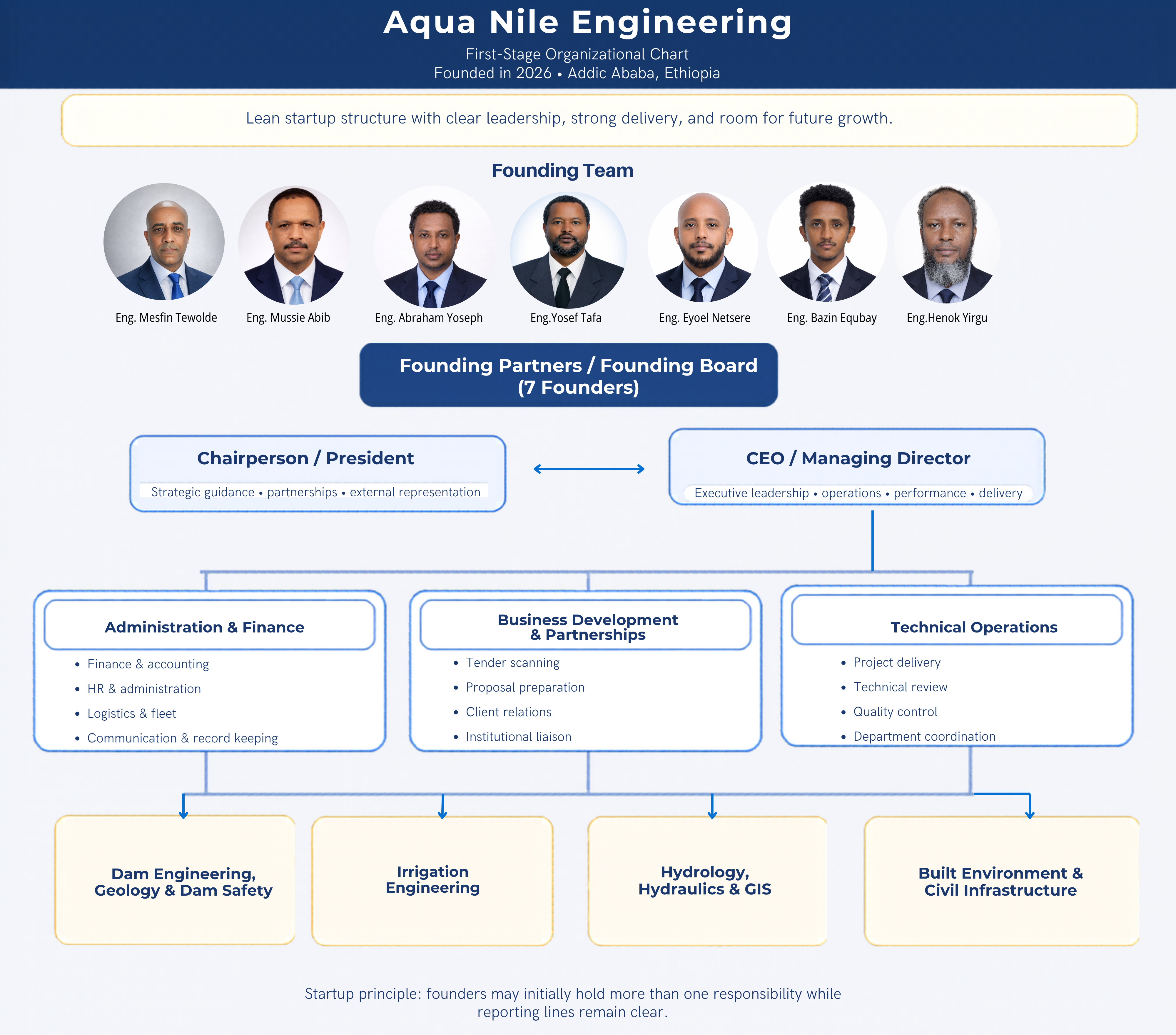
Signature Page
For and on behalf of the Founding Members of Aqua Nile Engineering Consultancy
Eng. Mussie Abib Taddesse Signature: __________________________
Eng. Mesfin Hagos Tewolde Signature: __________________________
Eng. Henok Yirgu Gebretsadik Signature: __________________________
Eng. Abraham Yoseph Duki Signature: __________________________
Eng. Eyoel Netsere Tadesse Signature: __________________________
Eng. Yosef Tafa Oba Signature: __________________________
Eng.Bazin Equbay Gebreamlack Signature: __________________________
Date: __________________________
Place: __________________________